What Is a Good Sleep Score?
The Lunomia Score gives every night one number from 0 to 100, worked out on your iPhone from how long you slept, how unbroken the night was, your deep and REM sleep, your schedule and your overnight readings. 80 or above is a great night. Here is how the score is built, what the five tiers mean, and what actually moves it.
What the Lunomia Score is
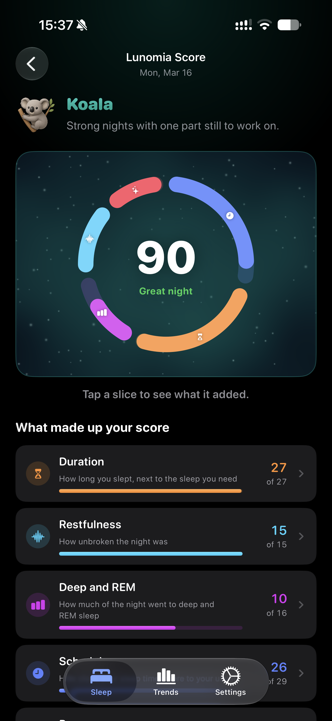
A sleep score is one number for a single night. The Lunomia Score pulls together everything Lunomia can read about that night instead of leaving you to weigh each chart yourself, then shows you exactly what raised or lowered it. Tap any slice of the ring to see how many points that part added.
Everything is worked out on your device. Your sleep data is never sent anywhere to produce the score.
The five parts of the score
Five parts make up every score, and they always add up to 100:
- Schedule (28 points): how close your sleep times were to your usual. Bedtime, wake-up time, the middle of the night, and how regular your schedule has been over the last two weeks.
- Duration (25 points): how long you slept, next to the sleep you need. Measured against a healthy range for your age and your own usual, and no other part can make up for a short night.
- Restfulness (20 points): how unbroken the night was. Sleep efficiency, time awake in bed, wake-ups and how long you took to fall asleep. Brief stirs under five minutes are not counted as wake-ups at all.
- Recovery (17 points): how your overnight readings compare with your own normal. Heart rate, heart rate variability, breathing rate, wrist temperature and blood oxygen.
- Deep and REM (10 points): how much of the night went to deep and REM sleep. Your watch estimates these, so they count for less.
When Lunomia cannot read one part, it is left out rather than counted as zero, and the remaining parts share the weight. A night tracked with your iPhone alone still gets a fair score; it is just built from fewer parts.
What counts as a good sleep score?
The score falls into one of five tiers, and each tier has its own sleep animals:
- 95 to 100, Radiant night: lion, bear, gorilla. Nights where almost everything went right.
- 80 to 94, Great night: cat, owl, koala, sloth, bat. Strong nights with one part still to work on.
- 60 to 79, Good night: raccoon, camel, arctic fox, meerkat, hedgehog, panda. Solid nights that leave some room.
- 40 to 59, Fair night: cow, giraffe, penguin, dolphin, crocodile, whale, seal. Nights that fell short in more than one way.
- 0 to 39, Rough night: elephant, rabbit, deer, walrus. Nights that gave you very little back.
Your score picks the tier, and the shape of your night (hours, stage mix and timing) picks the animal inside it, so a lion only ever means a top night and a koala is always a great one.
Why your score is personal
Most of the score is measured against your own recent nights rather than a fixed ideal. Lunomia builds a picture of your normal from about two weeks of nights, and the score reads as calibrating until then. You still get a number in the meantime; it just leans on general healthy ranges more than on you.
Healthy ranges always apply. The score will not tell you a four hour night was great just because you often sleep four hours. This is also why the same night can score differently for two people.
What it takes to score 100
A 100 needs a night that is healthy in length, largely unbroken, balanced between deep and REM, on your usual schedule, and with overnight readings at or better than your normal. A short night is the one thing no other part can make up for.
How to raise your sleep score
- Fix your wake time first. Schedule is the largest part at 28 points, and a steady wake-up anchors everything else. See how to fix your sleep schedule.
- Get closer to the sleep you need. Duration is 25 points and caps the whole score on short nights.
- Protect the night from wake-ups. Late alcohol and caffeine fragment the second half of the night, which costs Restfulness and Recovery points at the same time.
- Keep screens out of bed. Time awake in bed lowers your efficiency, and blocking apps at night is the easiest fix.
- Judge the trend, not one night. Deep and REM in particular are estimates; watch them over weeks.
Naps, iPhone-only nights and missing data
- Naps: adults get half of a nap counted toward their sleep need, up to a limit. Children and teenagers get the full length. A nap only helps when the night itself was short.
- No Apple Watch: any sleep saved to Apple Health works. Without stages or vitals, Duration, Restfulness and Schedule share the 100 points between them.
- Missing parts show as "No data" in the breakdown and are never scored as zero.
Sleep goals: tilt the score toward what matters to you
With Lunomia Pro you can pick what you would like to improve: a steadier schedule, more sleep, fewer wake-ups, deeper sleep, or waking up rested. Your score is weighted toward it. The five parts still add up to 100, so a goal shifts the balance rather than adding points, and your past scores are recalculated so your history stays comparable.
Free vs Pro
Last night's score, its tier and your sleep animal are free. Lunomia Pro opens the breakdown of what raised or lowered the score, your score history and the Lunomia Score trend chart, and sleep goals.
A note on limits. Lunomia is not a medical device. These are general reference ranges for adults, and your own normal values may fall outside them. Speak to a doctor about anything that worries you.
See your Lunomia Score tomorrow morning
One number for every night, worked out on your device. Free download.