Sleep Stages Explained: Deep vs Core vs REM
Every night you cycle through four sleep stages (awake, REM, core and deep) roughly every 90 minutes. Each stage has a different job, and the balance between them is what decides whether you wake up refreshed or foggy. Here's what your sleep chart is actually telling you.
The four stages on your chart
Deep sleep: the body's repair shop
Deep sleep (slow-wave sleep) is when physical restoration happens: tissue repair, immune activity, and growth-hormone release. It's concentrated in the first half of the night, and it's the stage that makes you feel physically rested. Most adults get roughly 10–20% of the night in deep sleep, often less than an hour, which surprises people.
REM sleep: the brain's processing time
REM (rapid eye movement) is when most vivid dreaming happens and when your brain consolidates memories and emotions. It dominates the second half of the night. A typical share is around 20–25%. Cut your night short and REM is what you lose first, one reason a consistent sleep schedule matters. Curious where those REM dreams come from? Read what does my dream mean?
Core sleep: the foundation
"Core" is Apple's name for light (N1/N2) sleep, and it's not filler. It makes up about half of your night and acts as the scaffolding between deep and REM cycles. Seeing a lot of core sleep is completely normal.
Awake: brief and normal
Everyone wakes briefly between cycles, usually without remembering it. Short awake spikes on your chart are normal; long or frequent awake blocks drag down your sleep efficiency and are worth investigating.
How much deep sleep do I need?
There's no magic number, but if you consistently see under ~10% deep sleep and you wake up unrefreshed, look at the usual suspects: alcohol in the evening (a notorious deep-sleep killer), late caffeine, irregular bedtimes, and a warm bedroom. The fix is rarely one trick; it's trends. Improve one habit, then watch whether your deep-sleep trend moves over two weeks.
Reading your stages in Lunomia
Lunomia takes the sleep stages your Apple Watch records and turns them into a chart you can read in seconds: the whole night on one timeline, totals and percentages per stage, and week/month trends so you can see whether changes actually work. Each night also gets a sleep animal: a night that scores high might make you a bear, while a rough one looks more like a walrus.
Deep and REM together are also one of the five parts of your Lunomia Score. They carry the least weight, 10 points out of 100, because a watch estimates stages rather than measuring them, so treat deep and REM as a trend over weeks rather than a verdict on one night.
- Download Lunomia free and connect Apple Health.
- Wear your Apple Watch to bed (setup guide).
- Open the app in the morning: your hypnogram, stage percentages and sleep animal are ready.
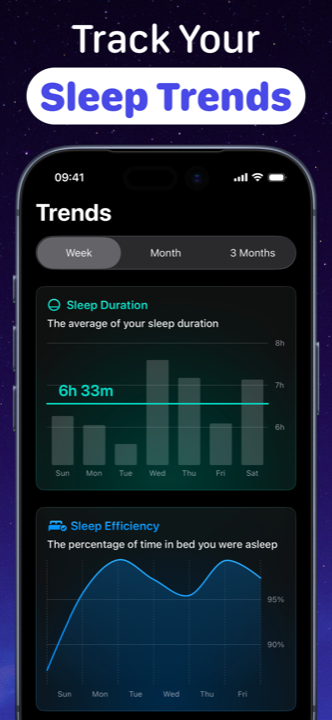
- Use the Trends tab to compare deep and REM sleep across weeks.
Rule of thumb: judge your sleep by weekly averages, not single nights. One bad night is noise; a two-week trend is signal.
See your sleep stages clearly
Deep, core and REM visualized every morning. Free, private, on-device.